Acta Orientalia Belgica XXXVI - DÉTAILS
Les écritures orientales : inventées, cryptées, détournées, oubliées, redécouvertes...
Christian CANNUYER in honorem
Édité par
Serge HOLVOET et Richard VEYMIERS
Avec le soutien de
Groupe de Recherche sur les Traditions Religieuses du Proche-Orient – Faculté de Théologie de Lille, du Centre d’études orientales - Institut Orientaliste de Louvain (CIOL), Louvain-la-Neuve et de Solidarité-Orient/Werk voor het Oost
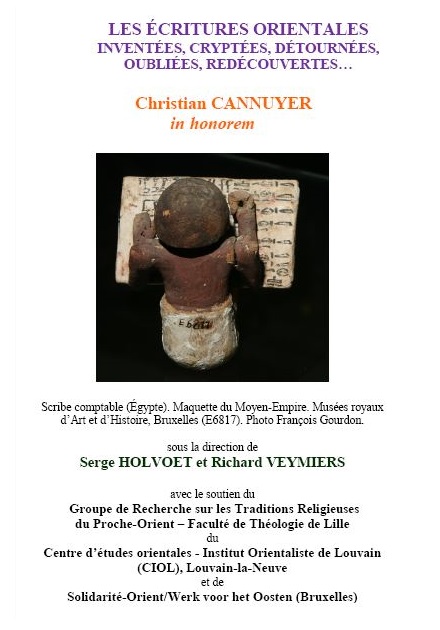
Illustration de couverture
Scribe comptable (Égypte). Maquette du Moyen-Empire. Musées royaux d’Art et d’Histoire, Bruxelles (E6817). Photo François Gourdon.
Commande
Vous pouvez commander ce volume en envoyant un e-mail à Christian CANNUYER.
Prix : 65 € + frais d'envoi
Corrigenda
Des corrigenda sont disponibles pour ce volume et peuvent être téléchargés en suivant le lien ci-après. → Corrigenda
Entre la page 203 et la page 204, la dernière page du magnifique article d'Alain Delattre a été escamotée, de manière incompréhensible, après les corrections d'épreuve. Pour la cohérence du livre, merci d'imprimer une nouvelle page 204 et de l'insérer (la coller) au bon endroit. → Page 204
Nota bene : Dans tous les volumes expédiés après le 4 juillet, la bonne page 204 a été collée sur celle imprimée initialement.
———
Les abstracts peuvent être consultés en suivant le lien ci-après. → Abstracts
En complément au volume, la bibliographie de Christian Cannuyer (1982-2023) peut être consultée en suivant le lien ci-après. → Bibliographie de Christian Cannuyer (1982-2023)
p. ix - Serge HUSTACHE, PRÉFACE
p. xiii - Serge HOLVOET et Richard VEYMIERS, CHRISTIAN CANNUYER, de la glèbe natale aux Orients d’hier et d’aujourd’hui : l’éclectisme enraciné d’un passeur de cultures. Notice bio-bibliographique
p. xxxv - TABULA GRATULATORIA
LES ÉCRITURES ORIENTALES
p. 3 - Karine MADRIGAL, Jacques-Joseph Champollion-Figeac : l’homme de l’ombre dans l’aventure du déchiffrement des hiéroglyphes
Jean-François Champollion, the hieroglyph decipher, had an older brother and mentor, Jacques-Joseph Champollion-Figeac. Aimé Champollion, one of the son of Jacques-Joseph, had the brilliant idea of keeping his fathers archives and classifying these various documents in the form of thematic volumes (60). A large part of these documents concerns the correspondence between the two brothers. The study of this archive conducted since July 2010, allows us to understand the role played by Jacques-Joseph Champollion. Jean-François Champollion was a genius in the raw state and thanks to his brother he was able to be channeled and guided to manage to decipher the hieroglyphs. It is a real tandem, one cannot exist without the other. Without the eldest brother, the name of the Champollion would not be associated today with the birth of Egyptology.
p. 21 - Marie-Cécile BRUWIER, Jean-François Champollion, polémique sur la nouvelle explication des hiéroglyphes d’Alexandre Lenoir
The publication of the first volume of the Nouvelle Explication des hiéroglyphes by Alexandre lenoir led the young Champollion, barely 18 years old, to take stock of the question of knowledge about egyptian civilization in 1809. His approach is still far from what he will formulate later when he understands the workings of egyptian hieroglyphic writing. nevertheless, Mariemont’s manuscript makes it possible to appreciate his impressive erudition, his criticism of sources, his concern to base his commentary on the study of original documents rather than on copies, and his appreciation of egyptian art. this methodology sheds light on egyptological science beginnings and the foundation which it establishes. One can undoubtedly note some misinterpretations and criticize the virulence of his critics toward his elder. in any case, the Mariemont manuscript reflects the effort of a « scientific » approach instead of another « esoteric » of ancient egypt, both of which still exist today.
p. 51 - Sydney H. AUFRÈRE et Nathalie BOSSON, Âmes mortes, coutumes traditionnelles psychoctones et tueurs d’âmes. Un procès chrétien intenté à la pensée hiéroglyphique par Chénouté d’Atripé (Ms Michigan 158 fos 13a-b)
The ms. Michigan 158, f. 13a-B is part of a sermon written in the sahidic coptic dialect by shenoute the archimandrite, abbot of the White Monastery. This text enables us to understand the way in which the author interprets the consequences of the so-called satanic fidelity to traditional egyptian traditions. Indeed, such a thought, conveyed by hieroglyphic writing, is supposed, according to him, to bring about the death of the souls of those who, instead of adhering to christian values, lock themselves into egyptian polytheism. according to shenoute, we infer that souls are not immortal by virtue of Plato’s philosophical heritage, but, as in origen, by virtue of a biblical heritage, that of a counter-gift from god recognising his people through their piety. carried by hieroglyphs considered as inefficient, that thought, considered as psychoctonic and bloody, would thus compete with the scripture of life vivifying souls (psychozoopoetics), darkness yielding to light, or vice versa. The ‘soul killers’ in shenoute’s mind are clearly grecoegyptian philosophers who encourage, through a secretly disseminated teaching, the preservation of ancestral customs as a last defence against a foreign religion – christianity – out of patriotic respect: We are thinking of characters such as Horapollon and his uncle, Heraiscos, who were tortured for their beliefs in Menouthis. shenoute, in his conclusion, deplores the considerable number of dead souls of false christians who adhere to such values, and suggests a reversibility of the relationship between Pagans–traditional temples and christian churches: It is the presence of real christians and Pagans that gives a place to the status of the church or the traditional temple respectively.
p. 97 - Claude OBSOMER, Sésostris alias Rhamsès-le-Grand dans la XVIIIe dynastie des frères Champollion
The purpose of this article is to present the sources used by the Champollion brothers and the interpretations they put forward, in their successive publications, at the different stages of their work of reconstructing pharaonic history. attention is focused on the names and kings « sesostris » and « ramses », but the kings symandyas and sethos, merenptah and amenophis are also studied.
p. 121 - Nadine CHERPION, Un cas d’écriture imagée : l’étrange représentation de nourrice de la tombe de Ken-Amon (TT 93)
After showing how, in the tomb of Ken-Amun (tt 93), the representation of Amenhotep II’s nurse demonstrates that this lady enjoyed a unique status, but also how many incongruous details this representation includes, the author wonders if this nurse was not entrusted with a peculiar function, the sexual education of the future king. other representations of royal and princely tutors (tt 78, 109, Meryrê’s stela vienna Äs 5814) have also been investigated. each of these examples illustrates the existence, in ancient egypt, of a writing system, parallel to the hieroglyphic system, coded and full of imagery.
p. 145 - Dimitri MEEKS, Aux origines anciennes de l’astrologie et de certains signes du zodiaque en Égypte
It is commonly admitted that astrology as it is still known today is of babylonian origin. However, long before the babylonian zodiac was adopted during the hellenistic period, egypt had its own system based on decans . this contribution investigates some specific features of egyptian astrology, and egyptian traits of some symbolic representations of zodiacal signs (Libra, Pisces, Sagittarius).
p. 165 - Nicolas GAUTHIER, Perles et coquilles des scribes à travers les légendes des Enfants d’Horus
From the beginning of the New Kingdom, it is common to find inversions in the representation and names of the Children of horus in private documents. Some of these are more complex, as can be seen in the Senhotep papyrus, where the content of the legend is disordered. the analysis of these inversions enables us to deepen our understanding of the process by which funerary papyri were made.
p. 177 - Didier DEVAUCHELLE et Ghislaine WIDMER, Deux nouvelles stèles du Sérapéum de Memphis
Publication of two modest stelae discovered by the Franco-egyptian mission of the Louvre at the Serapeum of Saqqara in 2021 during clearance works above the Lesser Vaults. the first one, in hieroglyphic script, could date back to year 23 of osorkon ii. the second, written in early Demotic, could attest the burial of a hitherto unknown Apis who might have died in year 28 of Artaxerxes i. those documents also testify to the variety of forms of the stelae used to praise Apis.
p. 185 - Alain DELATTRE, La cryptographie dans l’Égypte byzantine et médiévale. À propos d’un ostracon copte inédit
The contribution offers a synthesis of the various methods of cryptography uses in tLate Antique Egypt, mainly the permutation cipher αθβη, including its adaptation and developments, particularly in Coptic texts, but also other coding systems, based on numerals, letters (Caesar's cipher and its variants) or graphic distorsions of the letters of the alphabet. An unpublished Coptic ostracon from the late Bizantine or early Islamic period is then presented, which combines two differents ciphers in an original system.
p. 205 - Jacques VANSCHOONWINKEL, L’alphabet grec, des Φοινικήια γράμματα ?
Ancient Greeks as well as modern historians consider that the Greek alphabet derives from the Phoenician alphabet, as indicated by the expression Phoinikeia grammata which qualifies the Greek letters. This paper re-examines the question taking into consideration not only the epigraphic aspect, but also and above all the archaeological, historical and chronological data. it emerges from this analysis that the Greeks probably borrowed the west semitic linear alphabet from the semites of northern syria.
p. 235 - Stefan WIMMER, Jerusalem : the first written mentions
The city of Jerusalem – holding so eminent a place in the religious, cultural and historical perception of mankind – is but rarely mentioned by name in early, pre-exilic records (Iron and Bronze Ages). these are all collected and assessed here. In Hebrew sources, the name is first attested in the 7th cent. BCe. Akkadian cuneiform sources date back to the 14th (and 8th) cent. BCe. In egyptian records, Jerusalem is mentioned only in early curse inscriptions of the 19th and 18th cent. BCe. Its earliest mention in history is on a tiny sherd, which has often been overlooked.
p. 253 - Catherine VIALLE, De l’Écriture reçue à l’Écriture comprise. Une lecture de néhémie 8
This article proposes to study chapter 8 of the book of Nehemiah, focusing on the status of writing/Scripture. We shall begin by considering the role of writing, understood in its simplest sense in the narrative world of ezra-Nehemiah. We will then focus on the role of writing/Scripture in Neh 8, in continuity and in rupture with other episodes in the Bible that report a public reading of the Torah (ex 24:1-11 and 2 Kgs 23:1-3) and with which it enters into intertextuality.
p. 269 - Pauline DONCEEL-VOÛTE, Énigmes épigraphiques de Jérusalem, Qoumrân et environs : deux notes
1. inscriptions on stone weights : the majority of the stone scale weights discussed carry but the marks of the stone-workers’ tools; however some carry written engravings. the large Greek letters on certain items from Jerusalem and sites on the western Dead Sea shores can be read, with the help of comparisons, as « Year 5 of the king » more or less abbreviated. An additional information, MnA/« Mina », can also be read, indicating the standard unit commonly used in Syria-Palestine since Hellenistic times. So does the occasional formula « Mina of the market » which we have been able to identify. However no indication of the precise mass of each scale weight is associated with these formulae, which appear on weights of remarkably different sizes. the commercial transactions to be performed with these utensils were thus guaranteed exclusively by mentioning the authority of the king and the weight unit of the general system used. As to the identification of the « king » in whose « 5th year » this standard was controlled or adjusted, it can best be done with the help of numismatic history as, indeed, a new calibration of weights, scales and measures often occurs along with a numismatic event, such as the striking of a new type of coins. It is the 5 th and 6 th years of the reign of Agrippa I, the last king of Judaea, i.e. A.D. 40-42, that appear to offer the monetary and political context in which to best fit the various data discussed.
2. dead sea scrolls and messenger pigeons : remains of pigeon-houses and -towers in Jericho, Kypros and Masada, and in other large residential sites in ancient Palestine, are an incitement to research on messenger pigeons. We propose to consider as messages sent by air mail, that is by carrier pigeons, certain archival documents found around the Dead Sea, dating from Hellenistic and roman times, that have been classified as cryptic or esoteric scrolls. they are rolled up tightly and measure less than 10 cm, they may have been protected and wrapped in the small sheets of leather with laces which were found in the same contexts, they are often written on the reverse of another text, of a quite different purport (though never biblical) and they are in a lettering that is clear but unknown in the local ancient languages or incoherent as if organised according to some code, which would make them valuable witnesses evidence of historical events in those troubled times and areas.
p. 291 - Robert Martin KERR, Échos puniques du fantôme de Virgile au cimetière Mactaris ?
Roman-era neo-Punic epigraphy which is largely formulaic in nature, and which often imitates Latin epigraphical genres, still poses several interpretational difficulties, especially when the usual funerary and dedicatory locutions are not employed. ln this contribution, we propose an interpretation of the almost identical final phrases found in Hr Mactar 32-35, especially of the initial vocable hnkl. Our interpretation of the Punie bears a certain resemblance to a some,vhat obscure Latin funerary collocation, which is also found in a hexametric distich sometimes attributed to Vergil. lt would seem that at Mactar, a Punie city under increasing Roman influence during the High Empire, not just fixed Latin funerary expressions, but also Latin literary language were rendered in Punie.
p. 311 - Anne-Marie VELU, L’écriture arménienne : son origine, son histoire, son usage sur les miniatures liturgiques
The Armenian language has been spoken since the 6th century bC. As a result of its geographical position at the cross-roads of great empires, Armenia has always had contacts with other peoples and been at the mercy of foreign powers. to protect its language and culture, the king, in agreement with the patriarch, entrusted a linguist monk, Meshrop Mashtots (362-440), with creating an alphabet. Writing plays an integrating role in the identity of the Armenian people, and the illuminators of manuscripts give it a prominent place. A principal function of the inscriptions on Armenian illuminations is to identify the characters and to name the biblical scene represented. other inscriptions are more complex and develop the theme in order to help the reader to understand and to inform him. Finally, the script itself becomes decorative, with an abundance of letters in the shape of animals, birds, and plants, which are also loaded with meaning.
p. 335 - Jan M.J. VAN REETH, Vers les origines de l’alphabet arabe. Notes additionnelles
The oldest Arabic alphabet, pre-islamic in origin, has been one of the most perfect writing systems ever invented in mankind, designed to represent a complex phonetic system with a minimal number of different signs. We argue that, with some occidental influences, it was invented for practical reasons in the Christian Arab community of Mesopotamia, departing from the signs of the eastern Syriac script.
p. 347 - Daniel DE SMET, ‘Alī b. Abī Ṭālib et l’écriture himyarite, ou l’invention de l’écriture secrète ismaélienne
Some Ismā‘īlī manuscripts copied by the Bohras in India, mainly in the 19th and 20th centuries, contain passages in cipher. this practice seems to have been initiated by the Risāla al-Jāmi‘a, of which the oldest manuscripts are from the 13th century.
p. 359 - Jean-Charles DUCÈNE, Les hiéroglyphes dans l’Égypte médiévale : hermétisme, magie et talismanique
When the arabs entered egypt in the mid-7th century, the ancient egyptian script had long been illegible to the natives. But during the late ancient period, other interpretations of the hieroglyphs appeared: prophylactic, hermetic and alchemical according to the intellectual expectations of the readers who were interested in them. arab-Muslim scholars continue and feed these reinterpretations.
p. 371 - Samir ARBACHE, Évangile arabe et Coran arabe. Alphabet, langues, écritures. Synthèse provisoire
The Arabic alphabet, derived from Syriac in Syrian Christian circles, was perfected to become the alphabet of the Qur’an and of the Arab empire of Damascus. The Arabic Qur’an would originally be the Targum/translation-commentary of the Syriac lectio (qǝryānā). Also, the Qur’an refers to a considerable amount of biblical, apocryphal, Gnostic and other texts. It would therefore not be wrong to consider it as a partially translated text. By the time the Arabic Qur’an began to spread in the 8th century, the Christians, too, would have their Arabic Gospel.
p. 383 - Jean DRUEL, Milan, Kazan, Londres et Jérusalem : un codex du Kitāb de Sībawayh dépecé aux quatre coins du monde
The purpose of the present paper is to identify three folios in the Yehuda collection at the national Library of israel, catalogued under the call number 1181, as being part of a codex of Sībawayh’s Kitāb whose other membra disjecta have already been identified in milan (115 folios preserved in the ambrosiana, X 56 Sup.), in Kazan (48 folios preserved in the national archives of tatarstan, 10/5/822, identified by Geneviève Humbert) and in London (six folios on sale in the 2018/3 catalogue of bernard Quaritch, item no. 11, identified by umberto bongianino). more specifically, the three Jerusalem folios are part of a group of restored quires that were originally found at the beginning of the codex and of which eight other folios constitute the first of the 48 folios present in Kazan.
p. 397 - Alain SERVANTIE, Mosaïques d’écritures dans l’Empire ottoman
Since we started studying historical archives, we have noticed that Anatolia has used a great diversity of languages and scripts across the centuries. This diversity carried on during the Ottoman Empire : scriptures and alphabets were used on the basis of the religious education people got, not on the basis of their mother tongue. Thus Turkish could be written in Greek or Armenian characters. Albanian was written in Latin characters by Catholics, Greek, the Orthodox and Arabic by Muslims. Ladino, Spanish spoken by Jews, was written in Hebrew characters. Population migrations caused by wars and the alphabet change decided by Atatürk for Turkish have led to forget this diversity.
p. 419 - Marie-Anne PERSOONS, Script and national identity. What can we learn for Chinese history ?
This article proposes to revisit of a few episodes in Chinese history from the perspective of the complicated relation between national identity, on the one hand, and linguistic, cultural and ethnic identity, on the other. starting from developments in Chinese art as a mirror of a deeply stratified and multi-layered culture, it explores how the strongest imperial dynasties have succeeded in achieving unity through diversity, using the instrument of the Chinese script to reach their political objectives. The disruption caused by the Mongol rule (1279-1368) constitutes a pivotal moment for the shift from a cosmopolitan society to an overtly xenophobian one, characterised by an overemphasis on ethnic and cultural divisions. language reforms in the 20th century could not counter this evolution and the designation by the People’s republic of Chine of the Chinese language as Hànyǔ, in the sense of the language of the Hàn ethnic group only, may further exacerbate dividing trends.
MISCELLANEA
p. 433 - Gaëlle CHANTRAIN, Traduire les métaphores de l’égyptien ancien : attention aux « faux-amis » ! Une petite note de sémantique lexicale
This paper aims to introduce the new concept of “false friends” metaphors, which constitute a challenge for the translator and the philologist. this term applies to a linguistic metaphor which, when translated word-by-word, from the source language into a target language corresponds to an existing linguistic metaphor in the target language. the latter, however, despite its similarity on the formal level, does not have (exactly) the same meaning as the one in the source language. I shall illustrate here this concept with three examples: the metaphors of the broken heart, the heartless and the jumping heart.
p. 443 - Philippe HENNE, Le rire du Christ selon Basilide. Haine du monde et orgueil des intellectuels
In the 2nd century Basilides the Gnostic taught that Simon of Cyrene was crucified instead of Jesus and that the latter laughed at the sight of this confusion. This motif also appears in the Acts of John and in the Second Treaty of the Grand Seth. It implies a theology based on the conviction that the world is a big illusion created by a secondary spirit who claimed to be the only true God. Simon symbolised this illusory creation being put to death while Christ laughed at its condemnation.
p. 455 - Hans HAUBEN, Revisiting the Zenon Archive with an Egyptian Swineherd and Sailor Crying for Recognition
A short papyrus from the Zenon archive (P. Lond. VII 2007), dating back to December 248 BC, reports on an egyptian swineherd and former river captain in Zenon’s service, who, after having come into conflict with his employer, had taken refuge at an altar of the deified king, standing up for his rights. Having discussed the more technical and content-related aspects of the document in another publication, the present author took the opportunity to briefly revisit, in the specific light of this text and from a more personal and selective approach, the world which is concealed in the said archive. Special attention is devoted to the not always enviable situation of native egyptians in the «brave new world» resulting from alexander’s conquests and the third Greek colonisation wave. During the last decades, the (relative) importance of the national factor in the conflicts between egyptians and the Graeco-Macedonian upper class seems to have been slightly too much downplayed. after having attempted to grasp the exceptional figure of the talented but not always compassionate Mr. Zenon, the article concludes with a brief overview of judgments uttered in these respects by a few relatively recent Zenon specialists.
p. 473 - Manhal MAKHOUL, Note sur la tradition manuscrite arabe de L’Histoire de Zosime sur la vie des Bienheureux
This paper proposes to correct our previous list of arabic witnesses to Zosimus’ History with the Blessed Ones, by adding the manuscript Paris, Bibliothèque nationale de France, arabic 49, but excluding the Charfet manuscript, Convent of Charfet-lebanon, Rahmani collection 558, and the Vatican manuscript, Bibliotheca apostolica Vaticana, arabic 460, each of which preserves an account of a saint Zosimus, but which has nothing to do with Zosimus’ history with the Blessed Ones.
p. 481 - Marc MALEVEZ, Les charismes des moines de l’Antiquité tardive, preuves de leur perfection
After defining what charisms are the article first examines the most important of them, namely the discernment of spirits among the wandering monks of late antiquity. among those we find cardiognosy, which consists of discerning spirits in others. also related to this is the gift of vision, but also the charisms of forecasting and prediction. also related is the gift of exorcism. then come the supreme charisms of healing and resurrection. Finally, the article broaches the multiplicity of charisms among the holy monks.
p. 495 - Laura PARYS, La Complainte de Khâkhéperrê-séneb
The Complaint of Khakheperreseneb is a poetic piece that recounts the speech of a heliopolitan priest named Khakheperreseneb. immersed in a world governed by isfet (chaos, disorder), he complains to his conscience (ib) about the misfortunes that afflict the country. in the context of this study, we will be more specifically interested in a particular verse of his monologue, which addresses the issue of “loss of truth (mAat)” within the discourse. indeed, after lamenting the perpetuation of the critical situation in Egypt, he describes the breakdown of communication that has occurred there. This analysis will lead us to question the relationship between the ib-entity and the ma’at.
p. 507 - Lena PLEUGER, Le terme snṯ dans le Livre des Cavernes et le Livre de la Terre
The word snṯ is encountered on many occasions in funerary texts, particularly in the context of royal funerary compositions during the new kingdom. Its presence in this mysterious literature makes it a term whose translation is difficult to establish precisely. all the proposals put forward over the years refer either to the idea of a corpse or to a notion of flow related to a corpse. the tombs of the corpus (kV 9, kV 1, kV 6 et tt 33) offer eight occurrences of snṯ in the Book of the Earth ; thirty-five in the Book of Caverns. the different occurrences of the word reveal its multifaceted meaning, notably by using various determinatives (F 51, H 8, n 17, n 21, aa 02 et aa 03).
p. 521 - Lorelei VANDERHEYDEN, Une nouvelle attestation documentaire d’un sarakôte dans une lettre copte des archives de Dioscore d’Aphroditê
The papyri P.Cair.inv. S.R. 3733.5 and 6 ‘bis’ (soon published as P.Aphrod.Let.Copt. 4 and 5) are exceptional in many respects. even though they are in a poor state of preservation, these two rolled-together letters tell us an unusual story: a wandering monk has been incarcereted and laymen as well as clerics give him an alibi to free him from jail. these two letters also emphasize the fact that Coptic documentary sources can shed light upon wandering eremitism and provide vivid pieces of information, which are missing in the most commonly used literary sources that normally portray these hermits as degenerate monks. they are also evidence of how Coptic began to emerge as the language of some legal procedures. 34
p. 533 - Richard WEYMIERS, À propos d’un bronze énigmatique ayant appartenu à Nicolas-Claude Fabri de Peiresc
The National Library of France houses in its collection of antiquities a mysterious bronze object that has belonged to the famous antiquary Nicolas Fabri de Peiresc. this paper retraces the modern history of this artifact starting at the beginning of the seventeenth century, scrutinizes the meaning of its decor and explores its use during Late Roman Antiquity. this biographical approach sheds light on an astonishing object which has been intriguing many scholars and can be now identified as part of the luxurious chariot of a worshipper of isis.

