Acta Orientalia Belgica XXXVII - BIJZONDERHEDEN
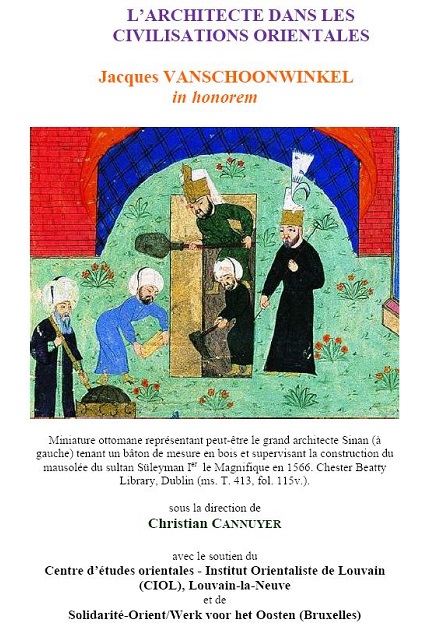
L'architecte dans les civilisations orientales
Jacques VANSCHOONWINKEL in honorem
Uitgegeven door
Christian CANNUYER
Met de steun van
Centre d’études orientales - Institut Orientaliste de Louvain (CIOL), Louvain-la-Neuve et de Solidarité-Orient/Werk voor het Oosten (Bruxelles)
Omslagontwerp
Miniature ottomane représentant peut-être le grand architecte Sinan (à gauche) tenant un bâton de mesure en bois et supervisant la construction du mausolée du sultan Süleyman Ier le Magnifique en 1566. Chester Beatty Library, Dublin (ms. T. 413, fol. 115v.)
Bestellen
U kunt dit nummer bestellen vestuur een e-mail aan Christian CANNUYER.
Prijs : 58 € + verzendkosten
———
La deuxième partie de l'article de Mr Medhi MOUSLIM, à savoir les pages 161 à 170, se sont malencontreusement intercalées entre les pages 202 et 203.
p. vii - Pauline DONCEEL-VOÛTE, Jacques VANSCHOONWINKEL, notice bio-bibliographique
p. xxiii - TABULA GRATULATORIA
L’ARCHITECTE DANS LES CIVILISATIONS ORIENTALES
p. 3 - Christian CANNUYER, « L’homme est argile et paille, Dieu est son bâtisseur » (Enseignement d’amenemopé, 24,9-20). Un rare écho égyptien au thème de ce volume
The theme of (a) god as architect of the universe seems absent in ancient egypt. On the other hand, the theme of a god who builds human beings is attested in chapter 25 of the Teaching of Amenemope (dating without certainty back to the end of the 12th or the beginning of the 11th century Bc). Man is presented as made of clay and straw, the work of a divine mason who can modify his work as he pleases. This aspect of man’s dependence on the gods is different from that of the biblical passages that are often considered comparable, where the emphasis is on the initial determination and election of man by God, who, in creating him, acts like a potter creating a vase with a clearly defined profile. The depiction of man made from a mixture of clay and straw in chapter 25 of Amenemope is undoubtedly merely metaphorical; if, on the contrary, it alludes to an anthropogonic myth, this is not otherwise attested in egyptian sources and is more reminiscent of the mythical substratum of certain biblical texts.
p. 13 - Apolline Marie HUIN, Les démiurges architectes dans la mythologie suméro-akkadienne
The Sumerian-Akkadian accounts of the creation of the cosmos that we will focus on here concern the work of the demiurges as architects or even craftsmen and engineers. First, we will recall the importance of the city in the environment of mankind in this region of the world; in this regard, several myths of the origins place the city as an element pre-existing to any creation or union. We will then look at the craftsmanship, town planning and architecture used by various deities to create the universe: surveying, foundations and construction are all skills used by Nisaba, ENKI/Ea, ENLIL and Marduk for his world-raft. Finally, we will see that the ziggurats, like the boat of the Flood, were imagined as models of the original Creation. 33
p. 29 - Arnaud DELHOVE, Le roi (re)bâtisseur dans quelques textes royaux couchites
The Sumerian-Akkadian accounts of the creation of the cosmos that we will focus on here concern the work of the demiurges as architects or even craftsmen and engineers. First, we will recall the importance of the city in the environment of mankind in this region of the world; in this regard, several myths of the origins place the city as an element pre-existing to any creation or union. We will then look at the craftsmanship, town planning and architecture used by various deities to create the universe: surveying, foundations and construction are all skills used by Nisaba, ENKI/Ea, ENLIL and Marduk for his world-raft. Finally, we will see that the ziggurats, like the boat of the Flood, were imagined as models of the original Creation. 33
p. 45 - Jacques VANSCHOONWINKEL, Les architectes des palais minoens ont-ils pris l’Orient pour modèle ?
The Minoan palace has a well-defined overall layout that distinguishes it from any other cretan building; it is characterised above all by the interweaving of several functions. as early as the beginning of the 20th century, arthur evans was convinced there was an eastern influence on Minoan palatial architecture, and this hypothesis was taken up after him. however, while Greek civilisation was open to eastern influences in many areas, this was clearly not the case in the genesis of the Minoan palaces. the Minoan palace is a pure product of the cretan genius and, if there are similarities with oriental palaces, it is because similar responses were used in the construction of these centres to fulfil equivalent functions, be they political, religious or economic, particularly in terms of storage and redistribution.
p. 61 - Raminder KAUR, The Supernatural Protection of Buddhist Monuments: a Comparison between the Inscriptions of Seṇavarma and Artaxerxes II
The construction of Buddhist monuments in early historic South Asia was an expensive business and supported by donors from different socio-cultural backgrounds. If these constructions and their donatory inscriptions were damaged, donors could potentially lose out on the merit resulting from their donations. Therefore, it was necessary to ensure that the monuments were protected in some way. This could have been through human protection, but some inscriptions suggest that donors wished to have additional ‘supernatural’ protection from gods, goddesses, deified ancestors, and the relics enshrined in stūpas, with the threat of hell or punishments for any damage caused. This paper focuses on the inscription of the Oḍi king Seṇavarma in comparison to one of the Persian Achaemenid king Artaxerxes II to discuss the idea of having supernatural protection for Buddhist monuments.
p. 93 - Xavier PHILIPPART, La figure de l’architecte chez Clément d’Alexandrie
Clement of Alexandria deals with many subjects in his work. By summarising different schools of thought, the Alexandrian church Father sheds light on a still emerging christian thought.. the figure of the architect only appears in the Stromateis. the aim of this study is to examine the theme of the architect and what is at stake. It appears that clement evokes this theme in three ways: a historical and apologetical approach, a theological observation and, finally, a hermeneutical discussion. In this context, the figure of the architect seems to serve clement as a tool for considering the question of the true knowledge. Beside the apologetic use of the figure of the architect, the common thread is indeed knowledge, that runs through the different quotes we have discussed.
p. 107 - Jan M.F. VAN REETH, Architecte et architecture du Temple céleste selon les traditions juive et syriaque (Aphraate)
Often Aphrahat, the most ancient author of the Syriac orient, is considered as completely devoid of Hellenistic cultural and philosophical influence. However, a close analysis of his allegorical presentation of the Temple of Jerusalem clearly demonstrates his dependence on a long exegetical tradition, going back to authors such as Philo and Clement of Alexandria, as well as Origenes.
p. 121 - Julien DECHARNEUX, Métaphores architecturales dans la cosmologie du Coran
This article undertakes an examination of passages in the Qur’ān that employ architectural metaphors within a cosmological framework. In addition to highlighting certain biblical and parabiblical precedents for these motifs, the study places particular emphasis on exploring the potential grounding of these motifs in the material culture that prevailed in the centuries prior to the emergence of the Qur’ān. specifically, the article posits that many of these cosmological motifs appear to build on late antique church architecture.
p. 137 - Daniel DE SMET, L’architecte comme causateur de la cause des causes (mu‘ill ‘illat a-‘ilal), selon le théologien druze Bahā’ al- Dīn al-Muqtanā
The Druze notion of the mu‘ill ‘illat al-‘ilal (“Causator of the cause of causes”) is anticipated by Proclus’ theory about the Ultimate as προαίτιος, which is the principle of causality of the cause of causes without being itself a cause. the Druze author Bahā’ al-Dīn al-muqtanā identifies the mu‘ill as the architect of the universe.
p. 143 - Jean-Charles DUCÈNE, L’architecte et son plan au Proche-Orient médiéval (13e-15e s.) : esquisse d’un problème
Although the Mamluk period witnessed the construction of a very large number of buil-dings in the Middle east, the people involved in their design and construction remain largely unknown. At best, specific functions with hierarchical roles and salaries appear among those individuals, although they often remain anonymous in narrative sources and epigraphy. As for the preparatory plan, it is not unknown, although it is rarely alluded to in the sources.
p. 155 - Medhi MOUSLIM, L’architecte et les métiers de la construction à Damas au 14e siècle à travers le regard d’un cadi de l’époque
The aim ofthis article is to outline the figure of the architect in Mamluk society through the eyes of a 14th-century Damascus judge who wrote an atypical work in which he describes one hundred and thirteen trades ofhis lime. To describe the figure of the architect and place it in context, we will begin by describing the society of the time: the Mamluk political system and the social divisions in 14th-century Syrian-Egyptian society. We will then examine how thisjudge, Taqî al-dîn al-Subkî (d. 1370), described the function of the architect and two other professions linked to the world of construction.
MISCELLANEA
p. 173 - Marjolaine CARLES, Les usages de l’eau dans les contextes miniers ibéro-américains : Potosí (Haut Pérou) et Ouro Preto (région centre-sud du Brésil) au 18e siècle
This study focuses on water uses in the Eighteenth Century Ibero-american mining contexts of Potosí (Peru) and ouro Preto (Brazil). It aims to put in perspective the Spanish and Portuguese Americas water challenges confronting metropolitan and local interests. Thus, the analysis focuses on the role of water within the eighteenth century mining explorations at a time of mining boom for both monarchies. This historical inquiry (archives exploration and prospections) includes studying mining technical aspects and water sharing, knowledge exchanges about hydraulic systems between settlers and local populations, labor regimes associated to water management and the socio-economic dynamics of water uses beyond the local scale, such as the consequences of water shortages as regards metal production (silver and gold). This survey pays a special attention to the impact of both metropolitan policies and economic balances on this local phenomenon. The study also demonstrates that studying water uses is particularly revealing to understand the evolution of colonial strategies.
p. 203 - Nadine CHERPION, Le cygne, un oiseau plein de promesses dans l’Égypte ancienne ? À propos d’une statuette (C 176) de la tombe de Toutânkhamon
The author proposes a new translation of the short text written next to the swan’s representation in the tombs of Toutânkhamon and of sethy II, as well as a possible interpretation of the presence of the palmiped in a funerary context.
p. 229 - Bernard COYAULT, L’Égypte noire, historiographie afrocentrée et renaissance culturelle africaine : généalogie et devenir d’une rupture épistémique
In 1954, Cheikh Anta Diop (1923-1986) of Senegal published Nations nègres et culture. For Diop, Pharaonic egypt (kemet) was a civilization built by Blacks, and this Black egyptian matrix was at the origin of Western civilization via Ancient Greece on the one hand, and of West and Central African civilizations on the other. The book aimed to rebuild an African historical consciousness in preparation for a continent-wide cultural and political renaissance. The thesis was violently rejected by Western scholars, who wavered between denial and contempt, disqualifying the work of numerous historical researchers from schools of egyptology opened in African capitals. This ideological war, fueled by humiliation and resentment, gradually gave rise to a historiographical regime of segregation. Over time, the debate went beyond scholarly circles, with the Diopian proposal inspiring a (transnational) counterculture based on Black egypt - the ancient matrix of all wisdom and knowledge. The conference questions the future of this epistemic rupture and the possibilities of re-establishing a conversation.
p. 285 - Arnaud DELHOVE, Ah s’il pouvait guérir ! (CT II, 343d) – Haroéris, un mutilé qualifié
The god Haroeris (Ḥr wr - Horus the elder) is a god whose rich theology, notably as a celestial god, developed throughout egyptian history. this article focuses on a dual aspect of the god, who is both mutilated (his eyes are injured) and a protector and healer. through extracts from the Pyramid texts and the Coffin texts, we can first examine the antiquity of the god with wounded eyes. then, looking at a much more recent source, the temple of kom ombo, through some monographs and scenes, we see the god as protector and healer, qualifications linked to his injury, which appears to be a qualifying mutilation.
p. 301 - Benjamin DETRY, Le colosse de Memnon : une figure de culte et d’émerveillement
Situated in front of the Mortuary temple in egyptian thebes, two twin statues of Amenhotep III, Pharaoh of the 18th Dynasty, drew the attention of the Greeks and Romans around the turn of the Christian era, ever since one of the two colossi had begun to produce a certain sound every morning at sunrise. fascinated by the longevity of Pharaonic civilisation, the Greeks assimilated egypt’s historical past to their own mythical times, and wanted to see in those statues the figure of Memnon, the trojan hero and son of Dawn. epigraphic and literary evidence tells us a great deal about travel in classical antiquity and the relationship between Ancient egypt and the Greco-Roman world. It appears that “tourism”, in the sense of a recreational journey conceived as an end in itself, did not exist in the strict sense of the term. nevertheless, throughout journeys undertaken for other purposes, whether professional, academic, or military, individuals of all social strata and of both sexes from the Greek and Roman societies often made stops at egypt’s grand monuments. In doing so, they occasionally left behind inscriptions, marking their passage, which have endured for over two millennia.
p. 319 - Jan GERRIS & Noor VAN BRUSSEL, The garbhopanishad, an Ancient Indian Treatise on the Human Embryo, Revisited in the Age of In-Vitro Fertilization
This paper examines a parallel between modern embryology and ancient indian texts concerning terms used for subsequent steps of development of early human embryos, exemplified by the Garbhopanishad. Though short and probably incomplete, several aspects of early human embryology are mentioned in this Upaniṣad: conception, embryo development during pregnancy, gender, congenital anomalies and twinning. uniquely, the embryo itself speaks in the first person, procuring peculiar insight in reincarnation. We discuss this in the context of classical indian literature about obstetrics and gynecology, modern views derived from human in-vitro fertilization as well as the view of contemporary authors on the topic.
p. 331 - Marc MALEVEZ, Miracles et charismes dans la Mission de Paphnuce / Vie d'Onuphre
“Life of Onnophrius”, also called “The Mission of Paphnutius”, is a travelogue of a Coptic monk in the desert of Scetis to meet different anchorites. the text presents miracles and also charisms of the monks. this article follows that of last year which presented the main types of charisms in the monks of the egyptian desert
p. 351 - Julie MARCHAND, Pipes en stock. Une caisse de matériel ottoman redécouverte au Musée Art & Histoire de Bruxelles
A box of Ottoman equipment containing a large number of pipes, pipe holders, lids and ceramic snuff boxes has recently been rediscovered at the Art & history Museum of the royal Museums for Art and history in Brussels. Also included in the lot are juglets and cup holders. The assemblage probably comes from Asyut, in the Middle nile Valley, whose pottery workshops flourished in the 19th century, and largely copied contemporary production in the Tophane district of Istanbul. After presenting this hitherto unpublished corpus, we will present Asyut’s production and then consider how it was distributed in Egypt and Europe. Finally, we will wonder about its presence in Brussels museum.
p. 365 - Patrick MARCHETTI, La « première guerre de Troie » et le roi Laomédon
A critical examination of modern theories, which set up troy (confused with ilion) on the site of hissarlik for the two wars that took place in “troy”, leads us to distinguish them. the first war, which serves as a setting for the second, as well as for the cycle derived from it, must have been an ancient epic independent of the war of the achaeans against ilion. the place of its unfolding is to be found in a “troy” located in central Greece, where “trojans/thracians” and Greeks lived side by side. the main hero must have been laomedon, son of erichthonios, like Pandion, and husband of the same zeuxippè as Pandion, which is enough to confuse the legends of both heroes. this leads to a reconstruction of the “first trojan war”, somewhere around sicyon, athens, Megara, salamis, and aegina.
p. 385 - Lena PLEUGER, Le cercueil d’Horsiésis. Une attestation du Livre de la Terre de la XXVIe dynastie
The anthropomorphic coffin of Horsiesis (Cairo Museum, TR. 21.11.16.14, TR. 21.11.16.15 and SR 11325/4) dated 26th Dynasty, is a fine example of the multiple use of different funerary compositions on the same object. The initial scene of the Book of the Gates is present on the foot, while two monumental doors open onto the Book of Amduat. on the lid, six scenes are taken from the corpus of the Book of the Earth, four of which are close to the versions of the burial chambers of Ramses VII (kV 1) and Ramses IX (kV 6), and two from the north wall of the tomb of Ramses VI (kV 9).
p. 407 - Jo Jan VANDENHEEDE, The Anglo-Prussian Diocese in Ottoman Jerusalem, 1841-1886 : An Ecumenical Exception and Example
In this article i will introduce the reader to the joint anglo-Prussian Diocese in Jerusalem in 19th c. ottoman Palestine: the arguments for its creation; its foundation and conditions; its bishops and their episcopacy; and its ultimate dissolution. i will also describe the present-day relationship between anglicans/episcopalians and Lutherans in the region, as well as wider anglo- and anglican-German Protestant ecumenical relations.

